Noise-immune quantum correlations of intense light
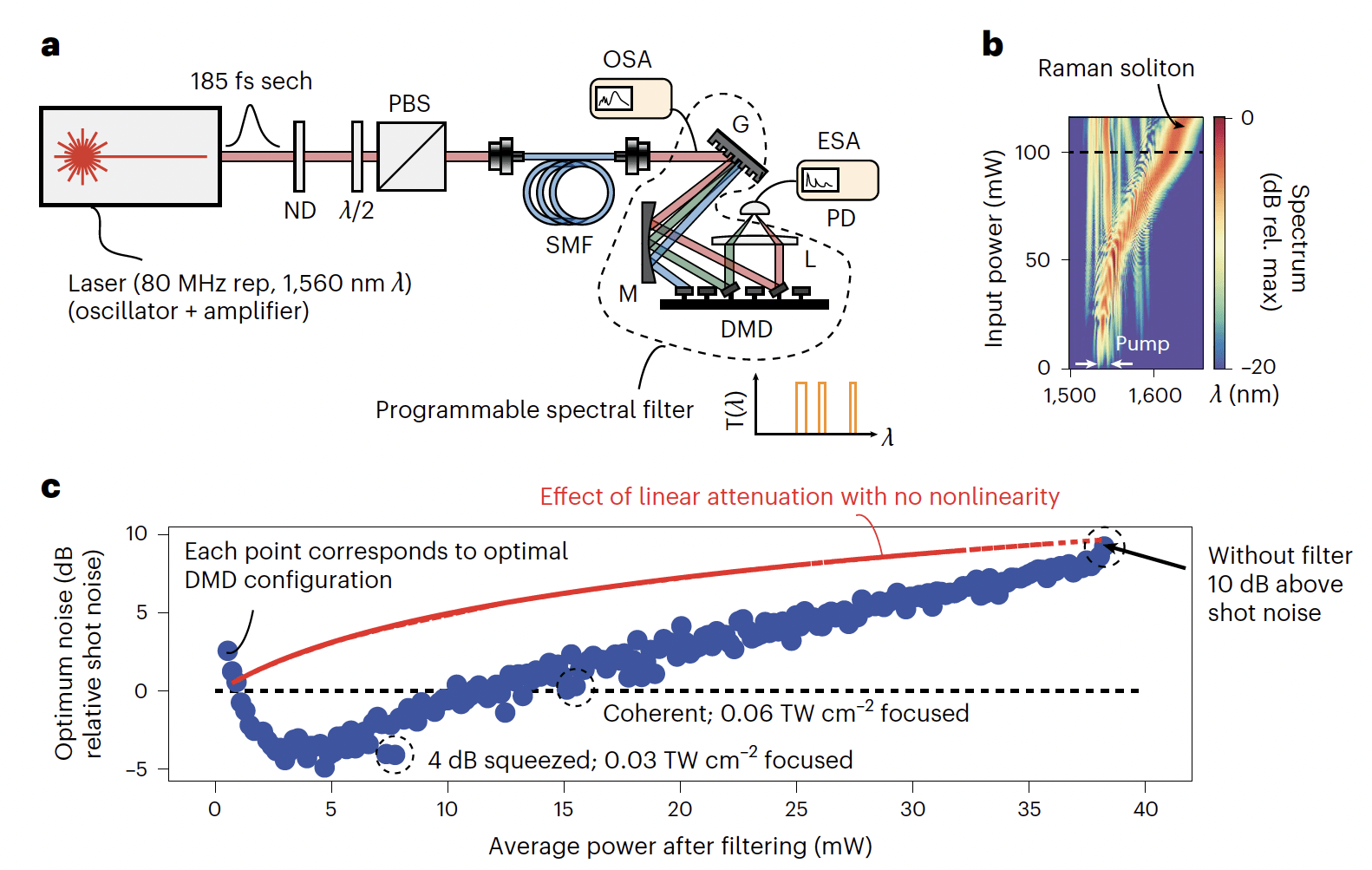
Noisy femtosecond pulses are sent into a single-mode fiber and spectrally demultiplexed before being sent to a programmable optical filter based on a digital micromirror device. For an optimal filter, squeezing can be generated for different levels of transmission of the output, despite strong excess noise at the input.
Lasers with high intensity generally exhibit strong intensity fluctuations far above the shot-noise level. Taming this noise is pivotal to a wide range of applications, both classical and quantum. In recent work, we demonstrated the creation of intense light with quantum levels of noise even when starting from inputs with large amounts of excess noise.
In particular, we demonstrate how intense squeezed light with intensities approaching 0.1 TW cm-2, but noise at or below the shot-noise level, can be produced from noisy inputs associated with high-power amplified laser sources. To capture the entire picture, we built a new theory of quantum noise in multimode nonlinear systems, allowing us to predict complex quantum noise effects in the presence of arbitrary input noise profiles and nonlinear dynamics.
This new theory, called quantum sensitivity analysis, revealed that the nonlinear dissipation process producing the squeezed light is essentially immune to the addition of noise in the pump. Consequently, the output noise is largely independent of the input level of noise. This noise-immune squeezing is a collective effect, arising from correlations between different modes created by nonlinearity: while any individual mode has strong noise, a group of modes together can almost completely decouple from noise, even in the noisiest channels of the input.
We call these noise-immune quantum correlations. This work was one of the first to study complex squeezing effects in the presence of excess noise and to uncover regimes where even without balanced detection, squeezing still survives. This extends the possibility of generating quantum light to a wider array of laser sources.
Related link: Nature Photonics