A framework for nanophotonically-enhanced scintillators
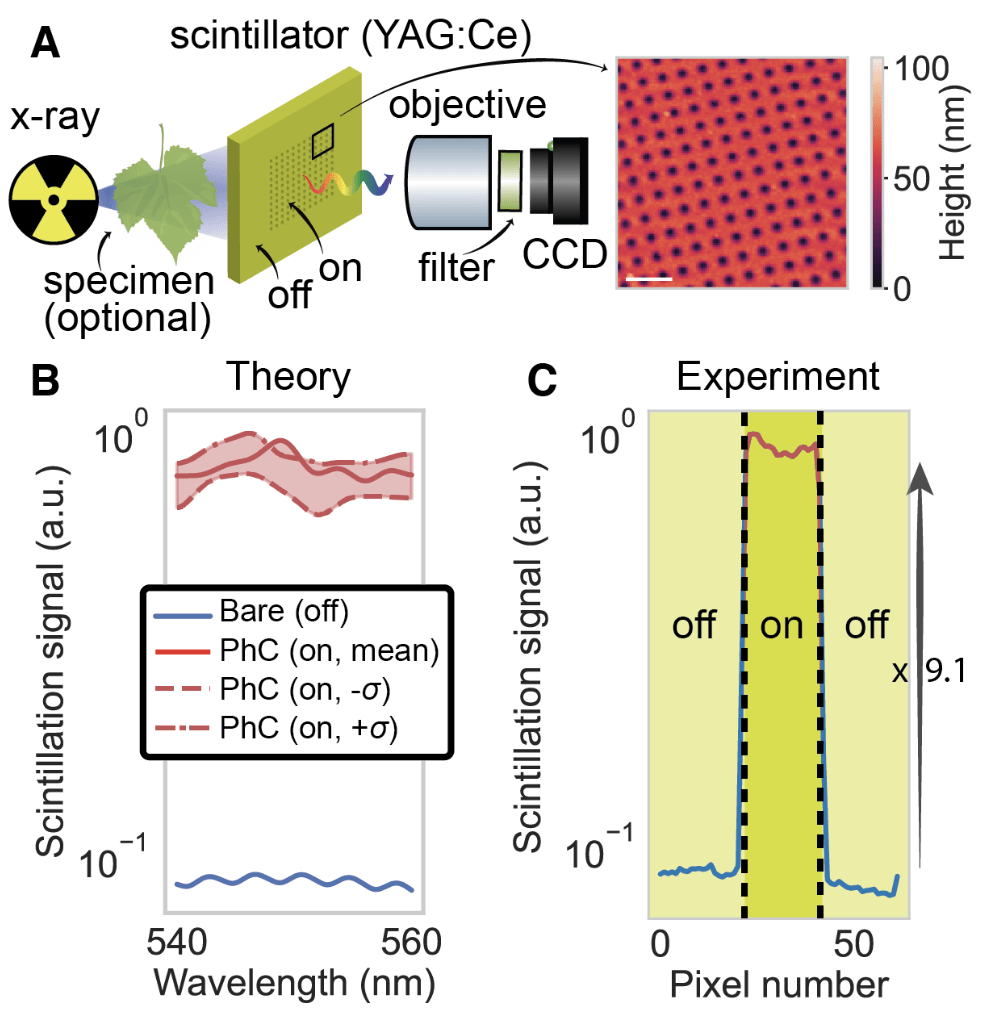
Nanophotonic structures can enhance the detection of ionizing radiation, such as X-rays and beta particles. Ionizing radiation is often detected using materials called scintillators, which emit light upon bombardment by the radiation. Since that radiation is dependent on the dispersion of light and the density of states, etching nanoscale patterns into scintillators can strongly influence light emission.
For example, we demonstrated that by etching photonic crystals, or periodic index-of-refraction modulations, on the surface of a scintillator, its light emission could be enhanced ten-fold. Critical to the design and realization was a computationally efficient and ab initio unified framework that described the key aspects of scintillation: the underlying emitter properties from density functional theory, the energy loss in materials by ionizing radiation, and the spontaneous emission by fluctuating currents in complex photonic structures.
The last part was made possible by exploiting optical reciprocity to transform the problem of emission into one of absorption, which is much more tractable. In the figure, X-rays bombard YAG:Ce, a scintillating material, leading to emission of yellow light. By patterning the scintillator with a focused-ion-beam-etched 2D photonic crystal, the light output could be enhanced 10-fold.
Related link: Science